
My Own Take: 'Oedipus' on Broadway

The show: “Oedipus,” created by Robert Icke, “after Sophocles,” on Broadway.
What makes it special?: It’s not often you get to see a Greek tragedy on Broadway. However, this is not quite that, but rather the English writer and director’s 2018 modern-dress version — produced ion the West End — and based the classic play (written approximately c. 429 BC according to some scholars). The production is also special because of its stars two dynamic actors: Mark Strong (Broadway’s “The View from the Bridge”) and Lesley Manville (TV’s “The Crown” and the films “The Phantom Thread,” “Mrs. Harris Goes to Paris,” “Queer”).

What makes Ickes version different?: This is not a tragedy in the classic sense of the protagonist having a fatal flaw, suffering from hubris or the like. This is more-or less a godless suspense story where the audience knows the ending from the beginning.
How about a refresher of the original play’s story?: Here it is in a nutshell: King Laius and Queen Jocasta of Thebes are told their son will kill dad and marry mum. To prevent this, they abandon their infant son to die. The child is rescued and survives, but later as an adult receives the same prophecy. Believing his adoptive parents are his real parents, he flees to save them from that fate. While traveling, Oedipus gets into a road-rage conflict, killing a man who turns out to be his father, King Laius, (though he doesn’t know that — yet.)
Arriving in Thebes, Oedipus solves the riddle of the Sphinx, saving the city, and is rewarded with the throne and the widowed Queen Jocasta (his mother). Then a plague strikes Thebes. The oracle states the murderer of Laius must be found to end it. Oedipus launches an investigation only to discover he is the killer. Devastated by the truth, Jocasta hangs herself and Oedipus blinds himself, then proceeds to go into exile. Curtain.
And in this version?: Oedipus is a strong, reformist, populist modern politician running for the highest office in an unnamed country. He has been long-married to Jocasta, the widow of the previous ruler, Laius, who was killed in an auto accident decades earlier. (Jocasta gave birth to a son by the much older Laius when she was 13, then, after he was killed, married Oedipus — 13 years her junior, hmmm. As it turns out when he was 18 he was in a fatal auto accident and fled the scene before learning any details of the incident.
Ickes version sets the play on election night when it appears that Oedipus will be the victor. In a news clip we learn that Oedipus is a man of the people who prizes honesty. (He has a “truth fetish,” later says his campaign manager.). At the end of the brutal campaign that challenged his origins and raised other nasty insinuations about his marriage, Oedipus promises to reveal his birth certificate and to investigate the death of Laius.
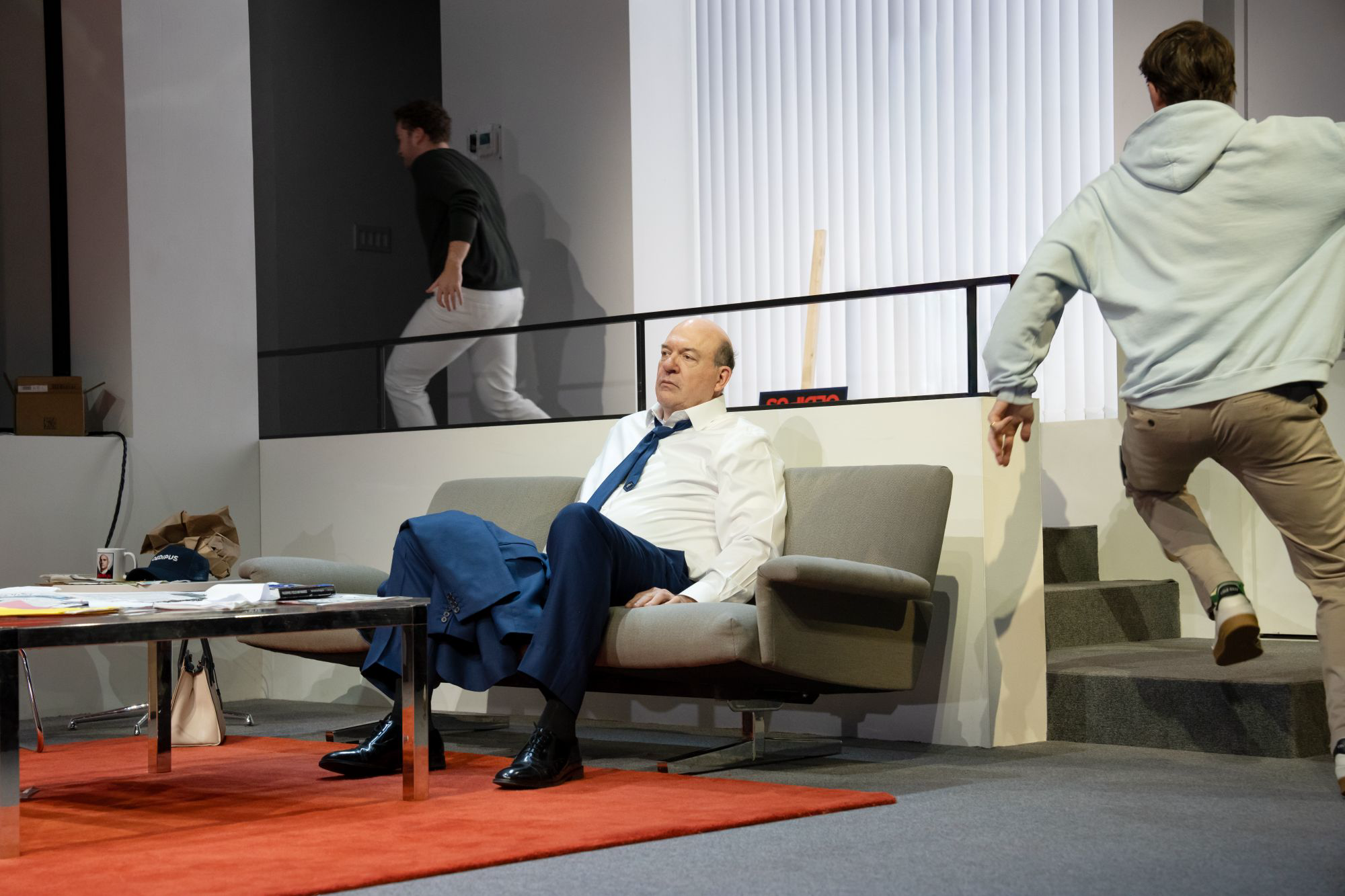
When the proper play opens Oedipus is celebrating the likely victory with Jocasta, his daughter, two sons, and brother-in-law Creon, his campaign manager (John Carroll Lynch, excellent). A fraught blind man Teiresias (Samuel Brewer) from a cult known for prophecy breaks in to warn Oedipus of the tragedy that will befall him (because he murdered his father and bedded his mother).
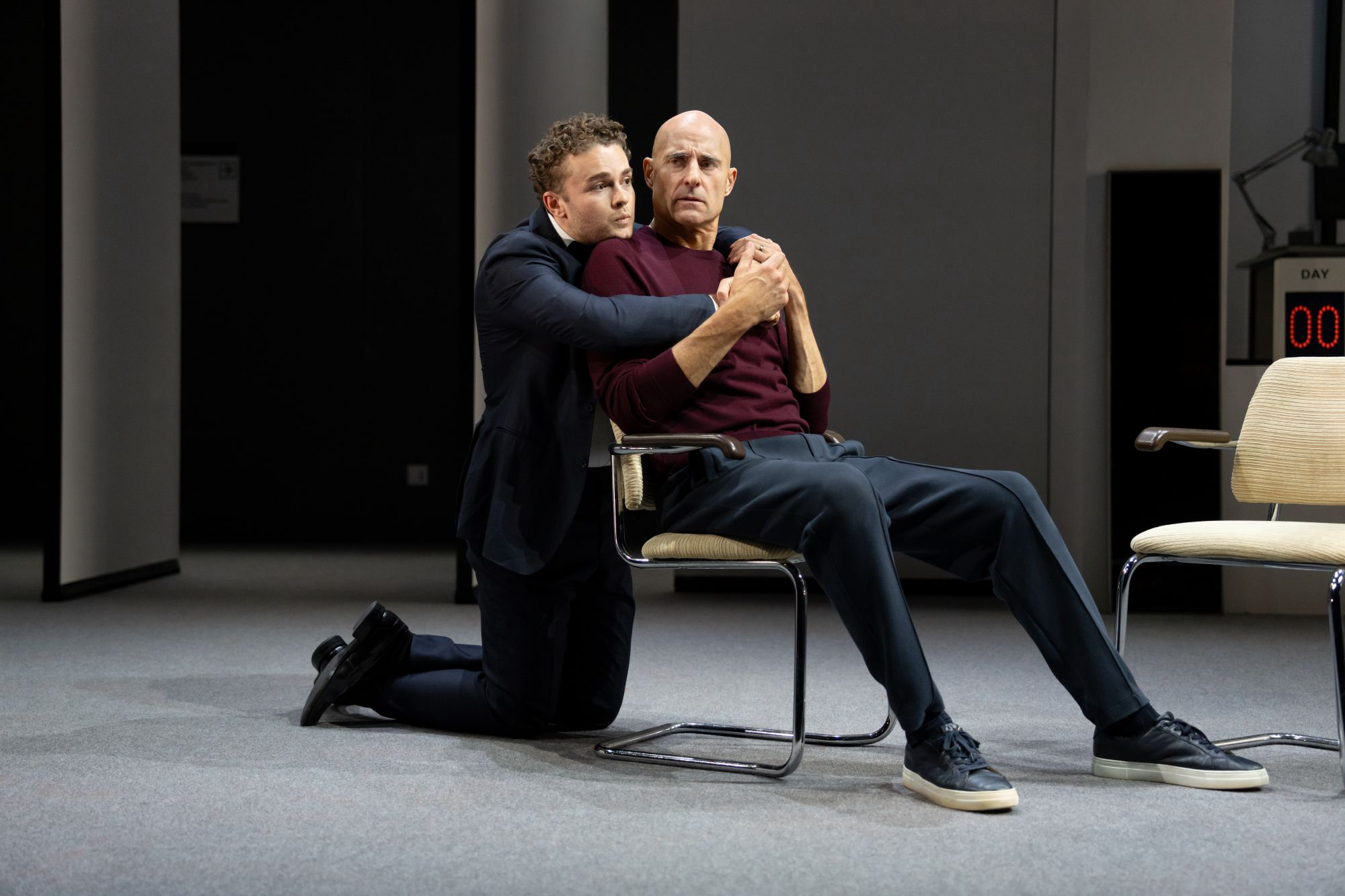
Merope (Anne Reid), Oedipus’s presumed birth mother, arrives and spends much of the night trying to talk to Oedipus privately to tell him some pivotal information about his birth but he keeps putting her off. Meanwhile, election returns come in as a digital clock ticks down, not to the moment of his victory, but to the moment of Oedipus’ shattering realization.
Sounds kind of twisty: It sure is and Ickes’ efforts to shoehorn much of the narrative of the original is quite a display of dramaturgical contortion. Some revisions simply don’t make sense while others are unintentionally comical. Oedipus has no time to speak privately with his mother — but he has time to get down and dirty with Jocasta? (The efforts of Meope to speak to Oedipus throughout the night is almost a running gag.) It makes no sense that Meroe’s husband (Oedipus’ father) who is on his deathbed has any effect on the man of the hour.
After a short while the multiple mother/child double entendres winking at the audience become a bit much. (“I actually tell people,’ I have four children,’” says Jocasta, referencing her husband. “Two at 20, one at 23 and one at 52.” Or: Jocasta chiding Oedipus: “You’ll be the death of me.” ) The glibness extends to the lobby where you can buy merch that reads: “Truth Is a Motherfu**er.”
Some new touches add little: The inter-family dynamic doesn’t go anywhere, including Antigone’s petulant anger at her mother and the sniping between Jocasta and her mother-in-law. One of their sons is outed as gay for little plot purpose other than to show what a sensitive dad Oedipus is, which is the opposite of the arrogance, ambition and powerful pride of Sophocles’ protagonist. This Oedipus is all-too earthbound and so is the tragedy of this production.
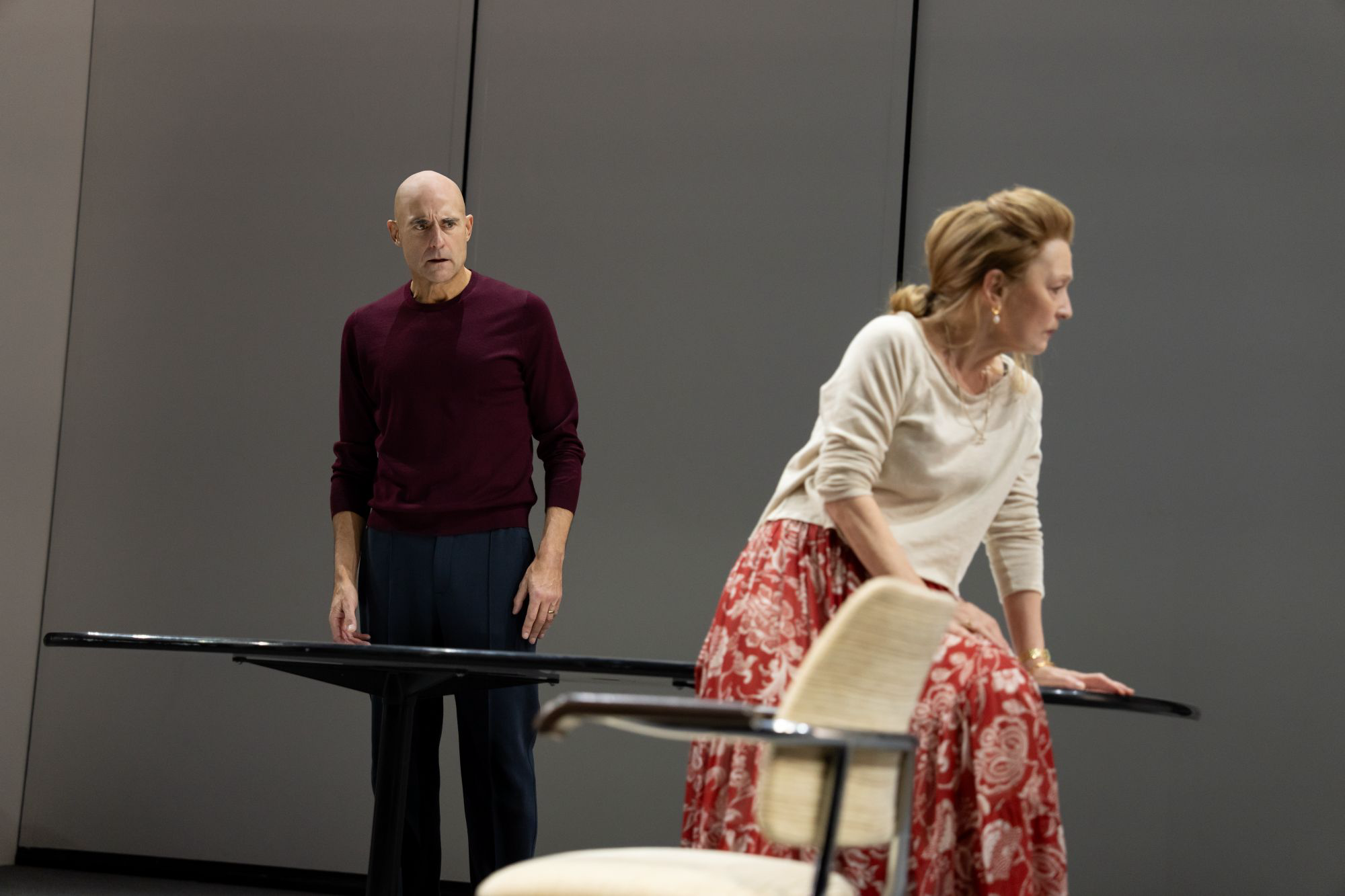
Also much is made of the importance of this rather sterile campaign quarters (designed by Hildegard Bechtler) where the family gathers for the celebratory dinner — as if this blank slate of a setting was comparable to the Ranevskaya homestead in “The Cherry Orchard.” But it’s just a cold and generic series of office rooms where an oddly catered meal is being set up, then dismantled. In a clunker of an epilogue — you can’t end the play with a suicide and an eye-gorge, can we? — Ickes creates a flashback when Jocasta and Oedipus first scouted the place when Oedipus began his political journey. But the significance is as cold and empty as the room — and the production.
Most tellingly, Ickes finds no equivalent of Sophocle’s Chorus — which observes and comments on the action in the original play and gives the work its epic gravitas The sense of fate, free will, destiny and the world of the gods is completely absent, and a few nods to a-power-larger-than-ourselves doesn't do the trick. Fundamentally, this Oedipus is not a tragic hero, just a guy who had some incredibly bad luck and timing. After all, killing his father was a drunken accident, not a result of his arrogance. Minus the gods, it’s just a lurid-but-hardly-divine soap opera.
And the performances?: Strong is a powerful and charismatic actor but under Ickes direction its hard to find a clear take on the character. However, together with Manville, they tear up the stage. Ickes does gives Jocasta her neglected due with a terrific 11th hour speech telling of her terrible first marriage (that began as rape when she was 13) and the birth and abandonment of her first son. Manville delivers it stunningly.

Who will like it?: Admirers of Strong and Manville (count me as one); perhaps those not familiar with the original; or those who just like radical versions of classics, no matter what.
Who won’t?: Greeks, classicists, and those looking for a work that soars to tragic heights. The gods wool;t be thrilled either.
For the kids?: You might have some explaining to do after the show.
Marquee quote: ‘Oedipus,’ not so complex.

Thoughts on leaving the parking lot?: Taking a big swing directorally can be thrilling. Other times, it can be well, yikes — like the staging when Oedipus and Jocasta discover the truth of their relationship and are on the floor writhing in horror at the news, with Jocasta giving a second “birth” to Oedipus. There’s also one helluva use of stilettos.

Info: This 14-week engagement at Studio 54, located at 254 West 54th St., end in early February. Running time of pproximately two hours with no intermission. Tickets can be purchased through the official production website, oedipustheplay.com, or via the Roundabout Theatre Company.. Mature themes, including scenes of a sexual nature and graphic violence. Late seating is not permitted.