
En Garde! New Haven Woman Fences For Fun -- And a Little Glory, Too
Think of fencing and what comes to mind? Errol Flynn as Robin Hood? Or perhaps other dashing characters like Zorro, Cyrano, or Inigo Montoya from “The Princess Bride?”
But for tens of thousands of everyday folk, they’re swashbucklers, too.
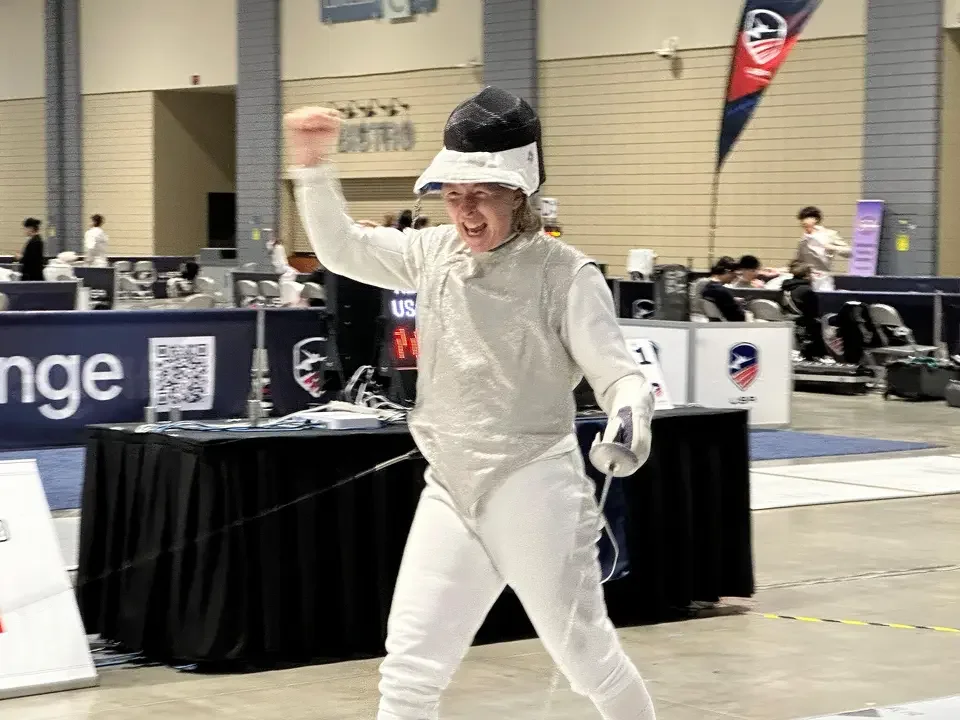
Before she took up fencing 12 years ago, Margaret Kerr couldn’t imagine herself brandishing a foil and competing in a national fencing competition. But in March in Cincinnati, Kerr, who lives in New Haven, won the USA Fencing usafencing.org foil competition for women in her age group (60 and older).
The competition is run by the national fencing organization and features various age groups of sportsmen and women in the categories of foil, sabre and epee styles of fencing.
Kerr, 60, is director of Education for the Center for Green Chemistry and Green Engineering where she is developing and running a certificate program through Yale’s School of the Environment. She competed in Richmond, Va. at the end of April which is part of a three-competition series leading to the Summer Nationals in Portland, Oregon in July. Kerr medaled in two events, taking the silver in the Veterans Women’s Foil for those over age 40 and bronze in the Veterans 60 Women’s Foil.
From there the points from winners of all those bouts will be tallied and the top four athletes in each age group will be selected for the U.S. team which will compete internationally this fall in Tbilisi, Georgia.
A certain flair
Kerr began her interest in “this totally under-the-radar sport” in Worcester where she worked and lived at the time. “It was actually on a whim,” she said. “I was going to the gym for exercise and to stay in shape. But I was getting bored with it so I began looking for something else to do. That’s when I discovered this (fencing) place in Worcester.”
While initially intimidating she quickly found the sport invigorating — and though she said she wasn’t very good at the beginning, participating in competitions dramatically improved her skillset. Over time Kerr discovered that she had a certain flair for the foil and soon fell in love with the sport, transitioning from recreational to competitive fencer.
Kerr is among the more than 45,000 members —from all ages (some as young as 8 and to those in their 80s) and levels of USA Fencing, the 135-year-old national organization of fencing enthusiasts.
“What Margaret's story shows us is something we see across fencing in 2025 — the sport has become a true lifelong pursuit. People discover fencing at any age and find community, competition, and a real intellectual challenge in the sport.” — Phil Andrews, CEO of USA Fencing.
USA Fencing’s competitions are open to participants aged 14 and up, with some events being mixed gender while others are separated by sex. Kerr, 60, recently entered the veteran category, which she competes in, as being for ages 60-69 for women in foil events.
“I think part of it is the mental engagement,” she said. “I’ve done a variety of individual and team sports since I was a kid but this is a sport where you’re trying to outwit your opponent at the same time they are trying to outwit you. There’s a push-and-pull that’s really absorbing. Plus it’s a lot of fun.”
But not always, said the Wyoming native.
“It can heartbreaking if you lose a round that is so important to you by a single point because it all happens so fast.”
Fencing qualities
Kerr, who practices at multiple fencing clubs in the New Haven area, said different qualities make up an expert fencer.
It’s more about how well you focus, she said. Speed, precision, timing and mental agility are key factors in the sport. "A bout is won in the mind before the blade,” is a classic quite from Olympian, Aladár Gerevich.
“A lot of it has to do with your ability to tamp down your adrenaline and emotions in the middle of everything that’s going on. It’s a martial art so you have to be under control at all times — or you lose.”
The blade is made of a steel alloy and is a tipped weapon that tapers to a half a centimeter, she said. When the tip depresses in a ‘hit” to the neck or torso, a wire that goes down into the grip registers whether a score is successful.
“You stab people — but in a safe way — and it’s also incredibly satisfying finding the perfect hit. Golfers talk about the perfect swing or whatever and it’s like that. It feels so very good at that moment.”
For Kerr, the sport is a positive experience that extends into her professional and personal life.
“We often identify by what job we’re doing or who our partners or our circle of friends are,” she said. “What this sport has done is open up this other piece of a life for me. It also has made me a better person in the sense the competition brings out your very best and I find that I can bring that positive attitude to other things that I do in my life.”
And for inquiring minds: “Yes,” she said, “we actually do say ‘En garde!’”